Mulder's Chart: Understanding Nutrient Interactions in Rose Cultivation
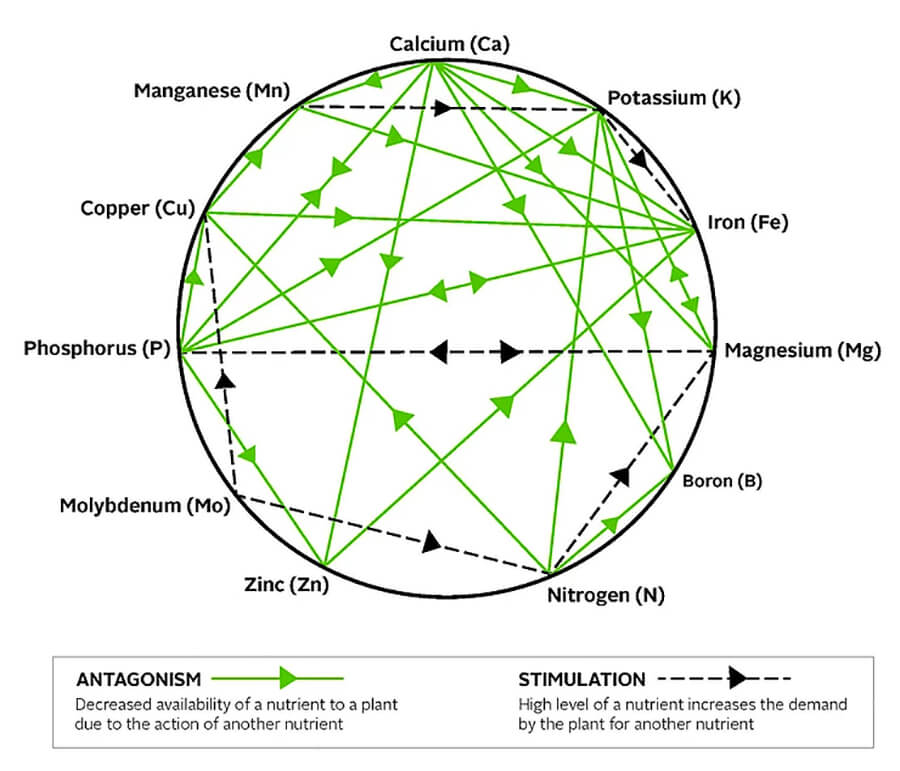
Mulder’s Chart is a visual roadmap that illustrates how different soil nutrients interact with one another, either by aiding (synergism) or hindering (antagonism) their uptake. In rose cultivation, it is a critical tool for maintaining the precise nutritional balance required for vigorous blooms and disease resistance.
Understanding the Chart
The chart maps two primary types of interactions between essential elements like Nitrogen (N), Phosphorus (P), and Potassium (K):
Antagonism (Inhibition): High levels of one nutrient can “block” or reduce the plant’s ability to absorb another.
Synergism (Stimulation): An increase in one nutrient enhances the plant’s demand for or uptake of another.
Key Nutrient Interactions in Roses
Using Mulder’s Chart, rose growers can avoid “induced deficiencies” caused by over-fertilizing:
Nitrogen (N) Imbalances
While roses need nitrogen for leafy growth, an excess can reduce the availability of Boron, Copper, and Potassium. Conversely, high nitrogen increases the rose’s demand for Magnesium.
Potassium (K) vs. Magnesium (Mg)
This is one of the most common issues in flowering plants. Over-applying potassium to boost blooms can inadvertently block magnesium uptake, leading to yellowing leaves (interveinal chlorosis).
Phosphorus (P) and Micronutrients
High phosphate levels—often found in “bloom booster” fertilizers—can significantly inhibit the uptake of Zinc, Iron, and Copper, which are vital for healthy rose stems and pigmentation.
Calcium (Ca) Excess
Over-liming or high-calcium soil can outcompete Potassium and Magnesium for root uptake sites, leading to stunted growth.
Practical Application for Rose Care
Monitor Nutrient Levels
Before adding “more” of a specific nutrient, evaluate whether a perceived deficiency is actually an “antagonism” caused by an excess of something else. Watch for visual symptoms and patterns over time.
Balanced Fertilization
Instead of high-dose NPK fertilizers, use balanced formulas or organic amendments that release nutrients slowly to avoid sudden spikes that trigger antagonistic effects.
Targeted Correction
If a rose shows signs of iron deficiency despite iron being present, consult Mulder’s Chart to see if high phosphorus or calcium levels are the root cause.
Common Scenarios and Solutions
Yellowing Leaves Despite Feeding
Problem: Your roses show yellowing between the veins (interveinal chlorosis) even though you’re fertilizing regularly.
Mulder’s Insight: Check if you’ve been using high-potassium bloom boosters. Excess K can block magnesium uptake.
Solution: Reduce potassium applications temporarily and apply magnesium sulfate (Epsom salt) at 1 tablespoon per gallon as a foliar spray.
Poor Iron Uptake
Problem: New leaves are pale or yellow, suggesting iron deficiency, but iron is present in your fertilizer.
Mulder’s Insight: High phosphorus from bloom boosters or high calcium from lime can both inhibit iron uptake.
Solution: Reduce phosphorus applications and consider using chelated iron (Fe-EDTA or Fe-DTPA) which is more available to plants.
Nitrogen Burns but Weak Growth
Problem: You see nitrogen burn symptoms (brown leaf tips) but plants still seem weak and lack vigor.
Mulder’s Insight: Excess nitrogen can block boron and copper, which are essential for cell wall strength and disease resistance.
Solution: Reduce nitrogen levels and ensure your fertilizer includes adequate micronutrients, especially boron and copper.
Understanding Synergistic Relationships
While antagonism gets most attention, synergistic relationships are equally important:
- Nitrogen ↔ Magnesium: Increasing nitrogen increases the plant’s demand for magnesium. Always ensure adequate Mg when using high-nitrogen fertilizers.
- Phosphorus ↔ Zinc: Higher phosphorus increases zinc demand, so zinc supplementation may be needed with phosphorus-heavy feeding.
- Potassium ↔ Nitrogen: These work together for overall plant vigor, but balance is key—neither should dominate.
Building a Mulder’s-Aware Fertilization Strategy
Step 1: Start with a Balanced Base
Use a complete fertilizer with all macro and micronutrients rather than relying on high-analysis NPK products.
Step 2: Avoid Single-Nutrient Spikes
Resist the temptation to add large doses of a single nutrient. Gradual, consistent feeding prevents antagonistic imbalances.
Step 3: Rotate Your Fertilizers
Consider rotating between different fertilizer formulations to prevent the buildup of any single element.
Step 4: Watch Your Plants
Learn to read your roses. Patterns of deficiency symptoms can reveal underlying antagonisms:
- Yellowing between veins → Check K/Mg balance
- Pale new growth → Check P/Fe or Ca/Fe balance
- Weak stems despite feeding → Check N/Cu or N/B balance
Step 5: Keep Records
Track what you apply and when symptoms appear. This helps you identify which nutrient combinations work—or clash—in your specific conditions.
The Bottom Line
Mulder’s Chart reminds us that more isn’t always better in rose nutrition. Sometimes, the solution to a deficiency isn’t adding more of that nutrient, but rather reducing another one that’s blocking its uptake.
By understanding these invisible interactions happening at the root level, you can:
✓ Avoid over-fertilization that causes more harm than good ✓ Diagnose mysterious deficiencies accurately ✓ Create truly balanced feeding programs ✓ Grow healthier, more resilient roses with better blooms
The next time you see a deficiency symptom, pause before reaching for a bottle of that specific nutrient. Ask yourself: “Could this be an antagonism?” Consult Mulder’s Chart, and you might find that the solution is counterintuitive—less of one thing rather than more of another.
Happy growing, and may your roses bloom in perfect balance!
Have you experienced nutrient antagonism in your rose garden? Share your stories and solutions in our community forum!